
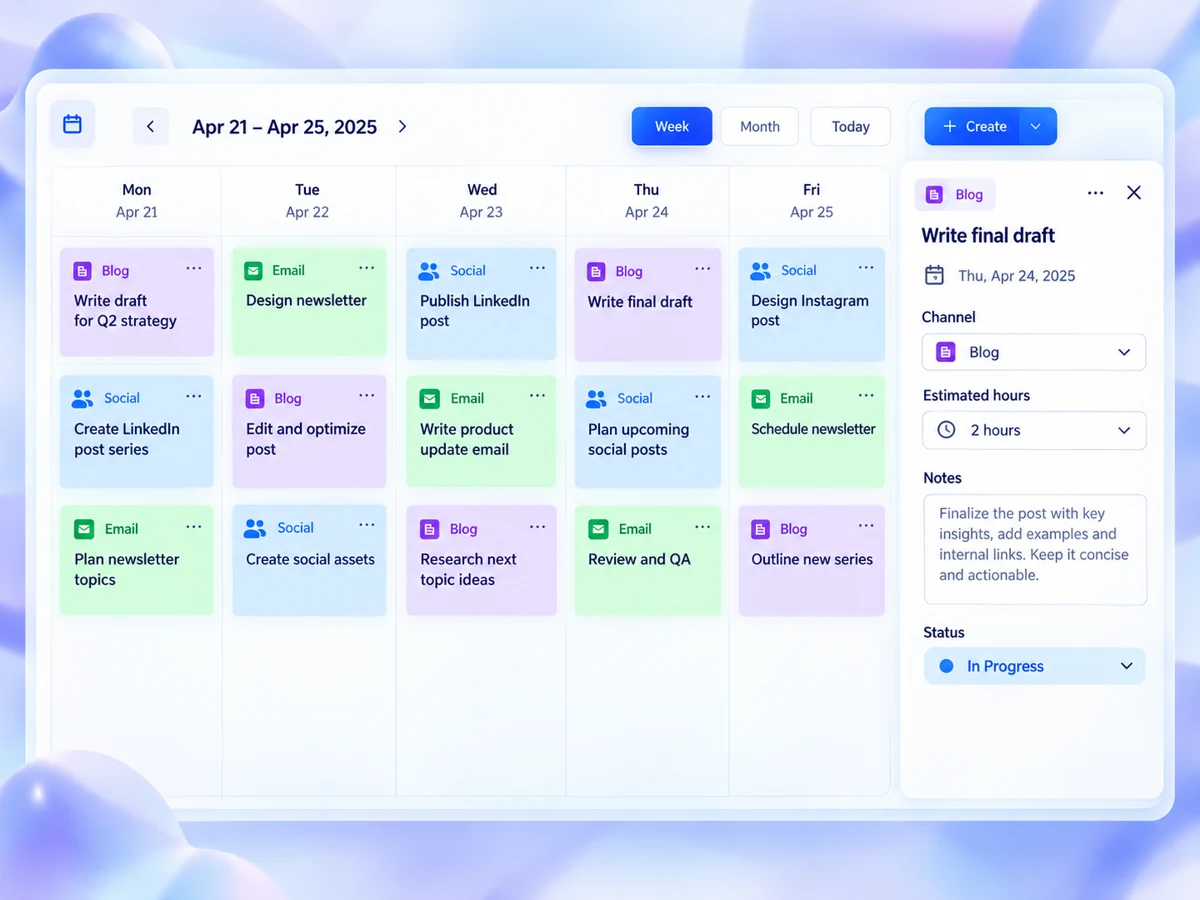

Plan your week around one customer question, then give each post a different job: identify a problem, explain a decision, demonstrate a change, address a concern and suggest an action. You do not need five unrelated ideas—or five publishing days. Build a small sequence for one main channel, then publish only as often as you can support with useful material and replies.
Choose an idea small enough to demonstrate
A broad theme such as “better websites” leaves too many decisions open. A useful weekly idea should help a particular reader do something specific. Look for a question from an enquiry, a recurring point of confusion or a task you can explain without extensive background. If you cannot describe the useful takeaway in one sentence, narrow the idea before drafting posts.
Example: a freelance web designer serving small service businesses chooses this idea: “Your contact page should explain what happens after someone sends an enquiry.” The reader can inspect their own page, understand the issue and consider a change. This is a hypothetical planning example, not a claim that changing a contact page will produce more enquiries.
Give each post a separate reader question
Use the same underlying advice throughout the week, but change what the reader gets from each post. Repeating a message can provide continuity; repeating the same explanation in slightly different words adds little. Before writing captions, assign each slot a question and an output.
- Monday — Spot the gap. Ask: “Does your contact page explain what happens after submission?” Offer a short inspection checklist covering the action, requested information and any stated response window.
- Tuesday — Explain the decision. Discuss why an accurate description of what happens after submission is more useful than a vague “Get in touch”. Invite readers to identify what they can honestly promise.
- Wednesday — Demonstrate the change. Show an illustrative rewrite: “Tell us about your project. We’ll review the details and email you about a suitable action.” Explicitly label it as an example to adapt.
- Thursday — Address a concern. Answer: “What if my response time varies?” Explain that readers should avoid a fixed turnaround promise unless their working process supports it.
- Friday — Offer an action. Invite readers to review their page using the week’s checklist. If contact-page work is genuinely part of your service, add a restrained invitation to enquire about it.
This is a five-slot menu, not a requirement to post every weekday. For a three-post week, keep the inspection, demonstration and invitation posts. Fold the explanation and concern into those captions. If two planned posts answer essentially the same question, combine them rather than filling a calendar slot.
Draft the useful core before choosing formats
Write a short source note containing the main advice, the example and its limitation. Then draft each post from that note. This keeps the message consistent without forcing you to reuse identical openings. Each post should still make sense alone: someone may encounter Wednesday’s demonstration without seeing Monday’s question.
Choose formats according to what needs showing and what you can maintain. A rewrite might work as a simple side-by-side visual; an explanation may need only a concise written post. Video adds recording and editing work, so use it when the demonstration benefits from movement or narration—not merely to make the calendar look varied. Start with one main channel rather than multiplying adaptations immediately.
Check accuracy and workload before scheduling
Batching reduces repeated drafting decisions, but it can also preserve an error across several posts. Review the shared advice first, then check each item in context. Leave room to change or pause the sequence if your availability, offer or audience circumstances change.
- Verify every promise, service description and response expectation against what the business can actually deliver.
- Check that illustrative wording is labelled as an example and does not imply a measured result.
- Preview each post for legibility and meaning on its own, including any visual or caption.
- Reserve time to answer reasonable questions; reduce the publishing schedule if replies would become unmanageable.
Run one week, then keep what earns its place
For your first trial, choose one question, prepare three core posts and keep two supporting ideas in reserve. Afterwards, note which questions people asked and which posts were difficult to produce. A quiet week does not prove the idea failed; distribution and audience size also affect what you observe. Use the review to choose one next action: revise the explanation, answer a follow-up question or reduce the workload before planning another week.