
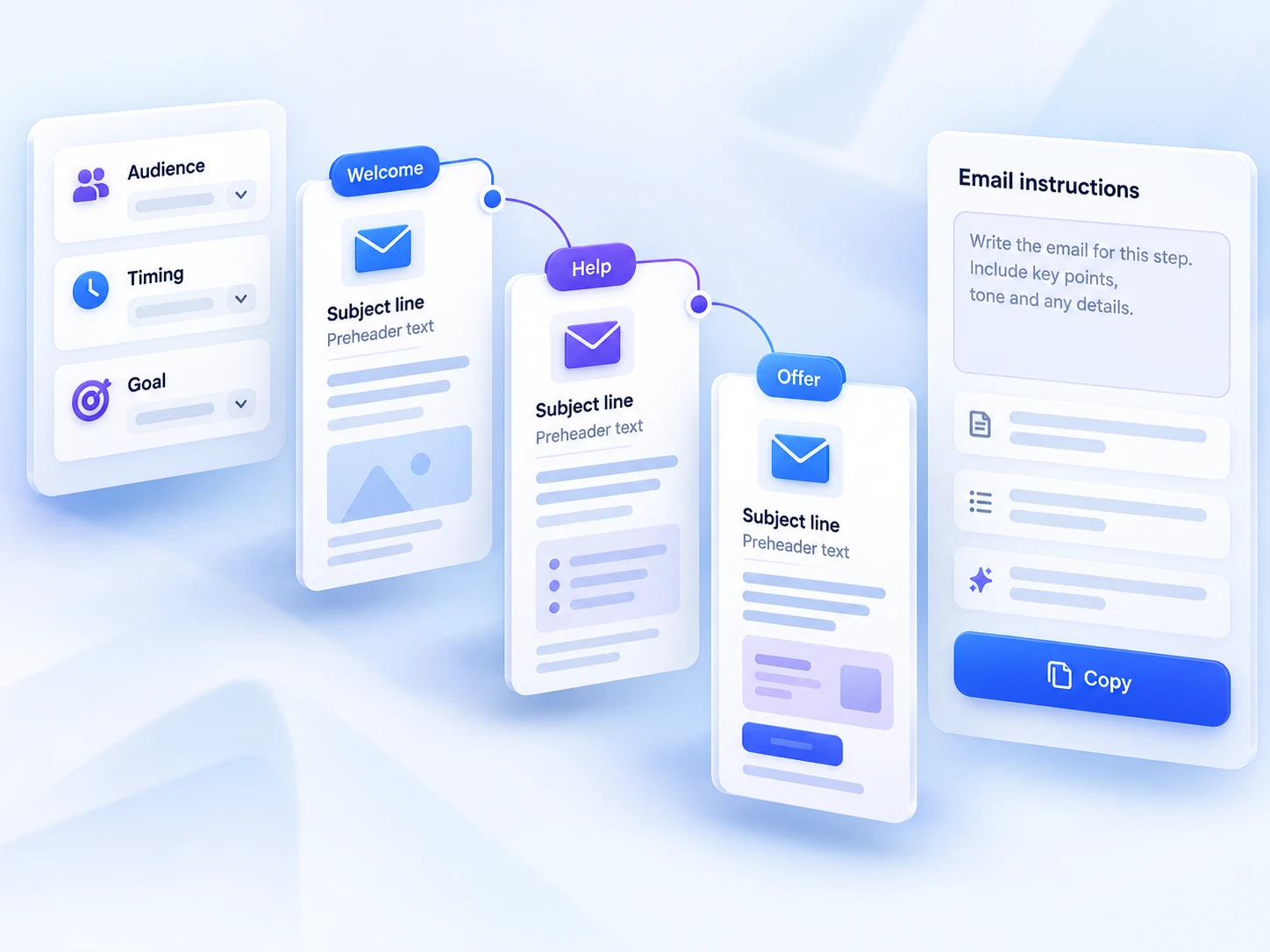
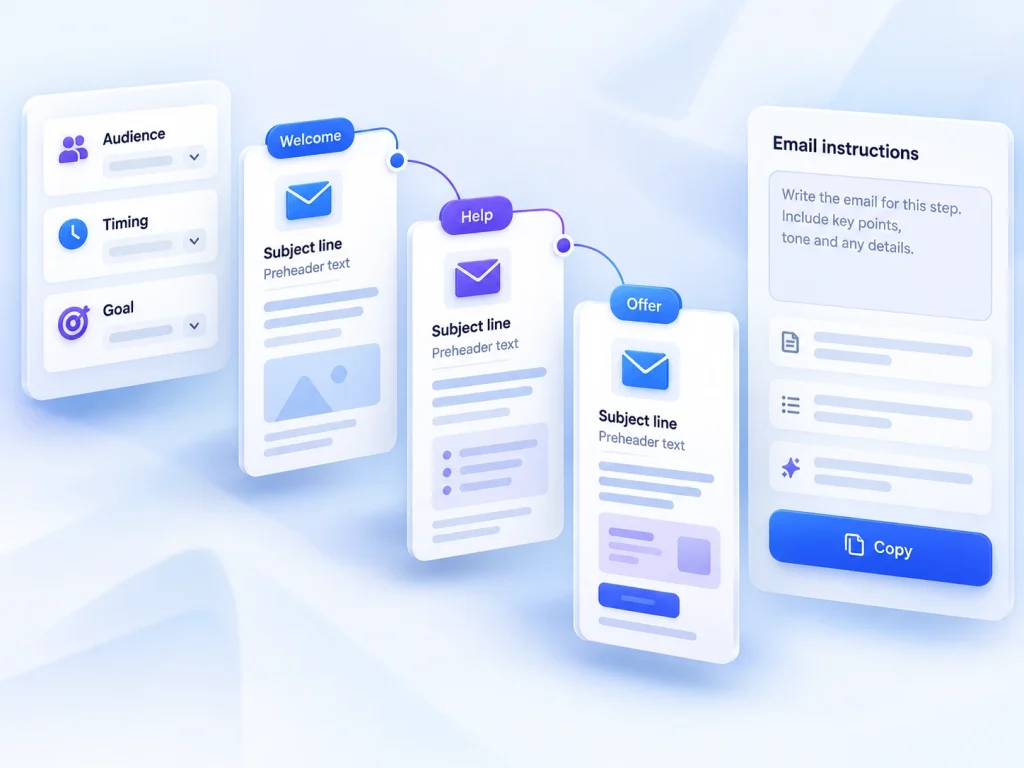
Map your welcome sequence in a document before building it in an email tool. Give each of five messages one job, one main action and a reason to arrive when it does. This makes gaps and repetition easier to spot without getting distracted by triggers or templates. Start with what the subscriber requested, then plan the smallest useful journey from receiving it to deciding whether your paid offer is relevant.
Start with the promise, not five empty emails
Copy the wording of your sign-up promise into the top of your planning document. Underneath it, write what someone should be able to do after using the resource. These two lines set the boundaries: the sequence should help people make progress on that task, not introduce every service you sell.
Example: a freelance designer offers a downloadable homepage planning worksheet to small business owners. The promised outcome is a more focused homepage brief. A relevant welcome sequence would help subscribers complete that brief; a detour into social media design would dilute the original purpose, even if the designer also sells it.
Give each message a different job
Use five rows in your document. For each row, record the reader’s question, the email’s job, its main action, its proposed timing and anything that needs checking later. Keep these as notes until the whole sequence makes sense. Polishing subject lines too early can make it harder to remove an unnecessary message.
- Email 1 — Deliver and orient. Answer “Where is what I requested?” Link to the worksheet, explain its purpose and suggest the first section to complete. State what follow-up emails will cover.
- Email 2 — Help them begin. Answer “What should I do first?” In the designer example, explain how to choose one main action for a homepage. Point back to the relevant worksheet section.
- Email 3 — Remove an obstacle. Answer “What if I get stuck?” Address one difficulty, such as having several audiences. Offer a simple decision rule rather than another broad lesson.
- Email 4 — Help them assess their draft. Answer “Is this ready to use?” Provide a short self-review: can a visitor identify the offer, intended customer and next action?
- Email 5 — Offer an appropriate action. Answer “Can I do this myself, or would help be useful?” Explain the designer’s paid homepage review, who it suits and what someone should have ready before enquiring.
Choose a pace that fits the task
Set timing according to the work you are asking people to do. Deliver the requested resource promptly; leave room between later messages for someone to use it. Example starting schedule: delivery on sign-up, followed by messages two, four, seven and ten days later. Treat that as a draft, not an established best schedule.
Closer spacing keeps guidance together but can feel demanding when each email asks for substantial work. Wider spacing allows more time but may require a brief reminder of the previous step. Check that your planned frequency matches what the sign-up page says. If someone joins your regular newsletter too, review the combined schedule rather than treating each stream in isolation.
Check the hand-offs and the offer
Read only the main action from each email in order. They should form a usable progression: get the worksheet, make a decision, resolve a difficulty, review the draft, consider help. If two actions are effectively identical, combine the messages or give one a different purpose. Five is a planning frame, not a requirement to stretch three useful ideas into five sends.
Keep the paid invitation connected to the task, but do not make it the missing piece required to use the promised free resource. Explain the scope of the offer and leave a credible do-it-yourself path. Avoid assuming that every subscriber has read earlier emails; each message needs enough context to make sense on its own.
Run a small rehearsal before automating
Draft the five messages and send previews to a small test list with permission. Ask testers what they think they signed up for, what they would do after each email and where instructions feel ambiguous. This checks comprehension, not commercial performance. A handful of reactions cannot establish the best timing or predict sales.
- Compare the sign-up wording with email one: is the promised resource easy to find and access?
- Open every main link on a phone and confirm that it reaches the intended resource or page.
- Read the sequence alongside any regular emails subscribers may receive and flag awkward overlaps.
- Mark changeable details, including offer scope and booking instructions, so you know what to review later.
Start with a planning document: write the sign-up promise and five distinct email jobs. Build the sequence once each email has a distinct purpose. Then test entry, delivery order and stopping rules in your chosen tool before inviting new subscribers into it.